
How to Increase the Average Transaction Value in Your Store with Frames and Hangers
There’s a sale that many gift shops and stationery stores miss out on every week without realizing it: the customer who has just bought a licensed poster and is immediately looking for a frame to hang it in. If the store doesn’t have the right frame or hanger, that customer will go elsewhere to find it, and the store will miss out on that cross-selling opportunity.
Most importantly: frames and hangers for posters don’t require a sales pitch. The customer already has an active intent to buy when they reach the display. All they need is to find the right product.
Why is wall decor an untapped opportunity for many retail locations?
Because demand is growing, and this product category is missing from their inventory. Searches for “wall art” on Google Trends rose by 74.5% between August and November 2024, reaching an all-time high during the holiday season, and remained at high levels in 2025.
Globally, the wall art market was valued at $23,316 million in 2025. The most relevant statistic for specialty retailers is this:
“45% of consumers prefer personalized wall art for home décor, which influences the frequency and variety of purchases.”
Source: Industry Research Biz — Wall Art Market Report, 2025 (industryresearch.biz)
For specialty retailers, this trend has a direct consequence: consumers who buy a licensed poster aren’t buying it to store it away. They’re buying it to hang it up. The frame or hanger is the logical next step—and if the store doesn’t carry them, the category remains incomplete.
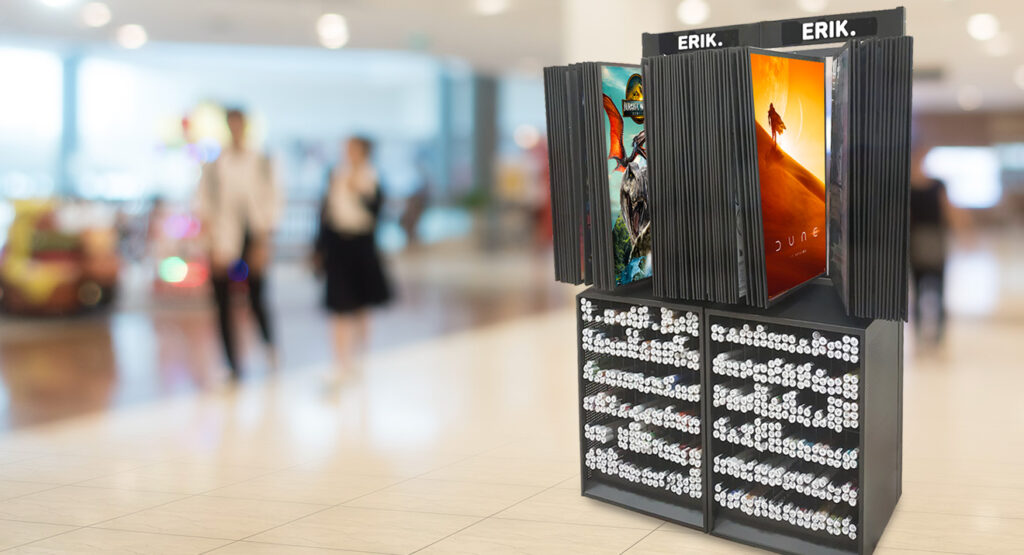
Why don’t most stores enjoy the operational advantages of having a single supplier for posters and frames?
In short: because they rely on multiple suppliers. Most stationery and gift shops that carry licensed posters do not use the same supplier for frames. They source posters from one specialty wholesaler and frames from another—or they simply do not carry frames in their assortment.
→ Check out Erik posters wholesale.
This fragmentation results in three specific costs for the retail location:
- Operational cost: two suppliers, two orders, two points of contact, two stock tracking systems.
- Opportunity cost: Customers who can’t find a frame in the same store where they bought the poster won’t return for the frame—they’ll buy it through another channel.
- Margin cost: Frames are one of the categories with the highest absolute margins in wall decor.
The most straightforward solution to these three problems is to work with a supplier that offers both posters and frames in the same catalog, under the same terms, and in a single order.
Frame or hanger: Which should you recommend based on the customer’s profile?
It depends on the budget and intended use. Frames and hangers are not synonymous nor do they compete with each other—they cater to two distinct buyer profiles. Carrying both at the point of sale is the best assortment decision, since you have the option of hangers for price-sensitive customers and the option of frames for those who prefer a more professional finish. In both cases, you can increase the average ticket.
The frame: permanent finish, higher average ticket
Definition: A frame is a perimeter support that frames the image with glass on the front and a rigid backing, presenting the poster as a finished wall piece.
Consumers who choose this option are looking for a very professional finish. It is the format with the highest average ticket per unit and the one that performs best in gift shops and among adult shoppers.
Furthermore, these are the best-selling items, as customers tend to prefer spending a little more to get a more polished and eye-catching finish.
The hanger: entry-level price, high turnover
Definition: A hanger is a mounting system that secures the poster directly without a perimeter frame, allowing for setup in seconds and a lower price.
Consumers who choose this option—typically a young audience that changes their decor frequently—prioritize speed and price. Not carrying them means losing sales to a price-sensitive audience. They aren’t “top-selling” items, like frames might be, but they sell well and have a very high margin.
The Cross-Selling Pitch
Having both on the display not only broadens the price range—it allows the salesperson to guide the purchase based on the customer’s profile without losing the sale. A customer who comes in looking for a hanger can be persuaded to upgrade to a frame with a finishing touch. A customer who comes in for a frame can also take a hanger for another smaller poster.
| Criteria | Frame | Hanger |
| Price for the end customer | Higher — includes frame, glass, and backing | Minimum — mounting system only |
| Visual finish | Finished piece, with edge and depth | Has edges only at the top and bottom |
| Ease of assembly | Requires only bending a few metal strips and removing the back panel. | Clip or magnet system; assembles in seconds |
| Reusability | High — you can change the content without disassembling | High — immediate poster replacement |
| Typical buyer profile | Adults looking for a permanent finish | Younger audience that frequently changes decor and is more price-sensitive |
| Average price per unit | Higher | Lower |
Which frame size has the highest turnover: 61×91.5, 50×70, or 30×40 cm?

The 61×91.5 cm size has the highest turnover—it is the standard for wall posters and accounts for the majority of demand in specialty stores, stationery shops, and gift shops. The 50×70 cm and 30×40 cm sizes are complementary.
The decision to purchase a frame is, above all, a decision based on size. Consumers know the size of their poster before arriving at the point of sale: if the display doesn’t have the correct size, no sale is possible, regardless of how many models are available.
A well-balanced assortment starts with maintaining a permanent stock of the highest-turnover size (61×91.5 cm) and complementary items in the other two sizes. This configuration handles the majority of purchases without the need to manage an extensive catalog.
Common mistake when setting up the product assortment
Common mistake: including only the 50×70 and 30×40 cm formats because they are the most common in general-interest catalogs, without including the 61×91.5 cm format, which is the best-selling size at specialty retail locations. The result is a display stand with items that don’t fit the posters.
How to incorporate frames and hangers into the product range without operational friction
Erik’s catalog of frames and hangers is integrated into the same order as the rest of the categories: posters, stationery, and merchandising. No additional supplier, no separate minimum order quantities, and the same personal account manager who is already familiar with your retail store’s product assortment.
Step 1: Access the full catalog starting with your first order—no minimum order amount required.
Step 2: Add frames to your regular poster order.
Step 3: Your personal account manager will advise you on which formats and SKUs have the highest turnover based on your store’s profile.
- No minimum order—access the catalog starting with your very first order, regardless of the amount.
- Payment deferred for 30 days starting with your third order.
- Assigned personal account manager—guidance on the formats and SKUs with the highest turnover based on your store type.
- Early access to new catalog items before they’re released to the general public.
Browse the complete Erik catalog of picture frames and hangers and curate your wall decor selection with a company that has specialized in this field for over 30 years.
Frequently Asked Questions About Wholesale Frames and Hangers
What is the difference between a frame and a poster hanger?
A frame is a perimeter support with glass on the front and a rigid back—the poster is displayed as a finished piece. A hanger holds the poster without a perimeter frame; it can be mounted in seconds and is less expensive. For retail stores, carrying both options broadens the price range within the category and allows you to tailor sales to the end customer’s budget.
Which frame size has the highest turnover in stores?
The 61×91.5 cm size has the highest turnover—it’s the standard for wall posters. The 50×70 cm and 30×40 cm formats are complementary and also have high and consistent turnover. The most common mistake is not having the 61×91.5 cm format in stock and losing sales on large-format posters.
How do frames and hangers increase the average ticket?
A consumer who buys a poster immediately looks for a way to hang it. If the retail location has the frame or hanger in stock, the sale is closed on the spot. Without that accessory, the customer will go elsewhere to find it and will also make that second purchase.
Can I combine frames with posters in the same order from Erik?
Yes. Frames and hangers can be combined with any other category in the catalog—posters, stationery, merchandise—in the same order, with no separate minimum order quantities, under the same commercial terms, and with the same account manager.